

If you're looking for a new primary care provider, or don't have one yet, you've probably noticed that the letters after a provider's name vary: MD, DO, PA-C. It's natural to wonder what those titles mean, how the roles differ, and which one is the right fit for you.
Here's the good news up front: all three are highly trained, licensed medical professionals, and any of them can be an excellent primary care provider. This guide walks through what each title means so you can choose with confidence.
What is a physician?
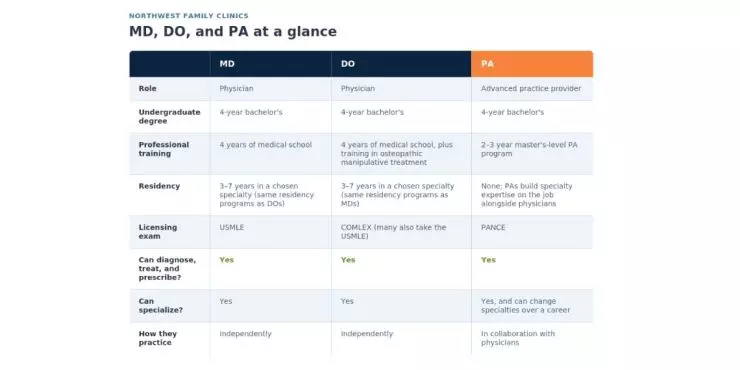
A physician is a doctor who has completed medical school and residency training. In the United States, physicians earn one of two degrees: the MD (Doctor of Medicine) or the DO (Doctor of Osteopathic Medicine). Both are fully licensed physicians with the same rights and responsibilities. Both can practice in any specialty, prescribe any medication, perform surgery, and lead a patient's care.
Think of MD and DO as two roads that lead to the same destination. The scenery along the way differs a little, but both arrive at the same place: a fully trained physician.

The path to becoming an MD or DO
- Undergraduate degree: A four-year bachelor's degree, usually in the sciences.
- Medical school: Four years covering anatomy, physiology, pharmacology, pathology, and clinical medicine, along with hands-on rotations in hospitals and clinics. DO programs include additional training in the musculoskeletal system and a hands-on approach called osteopathic manipulative treatment (OMT).
- Residency: Three to seven years of supervised training in a chosen specialty such as family medicine, pediatrics, internal medicine, obstetrics and gynecology, orthopedics, neurology, dermatology, rheumatology, or surgery. MDs and DOs train in the same residency programs, side by side.
- Licensing and board certification: MDs take the USMLE licensing exams; DOs take the COMLEX (and many also take the USMLE). Both then earn board certification in their specialty and maintain it through ongoing education.
What is osteopathic manipulative treatment?
OMT is a set of hands-on techniques DOs learn for evaluating and treating the muscles, joints, and connective tissue. Some DOs use it regularly in their practice, especially for back pain, neck pain, and other musculoskeletal concerns. Others use it occasionally or as one option among many. Either way, it's an added skill in the toolkit, not a different kind of medicine.
Do MDs and DOs approach care differently?
Not in any way you're likely to notice at a visit. Both practice evidence-based medicine, both treat the whole person, and both emphasize prevention and healthy living. Osteopathic medicine grew from a philosophy that stresses the connection between body systems and the body's capacity to heal with the right support, and that philosophy is now shared broadly across modern medicine. What matters most for your care is your physician's specialty, experience, and how well you communicate with each other, not which degree is on the diploma.
What is a physician assistant?
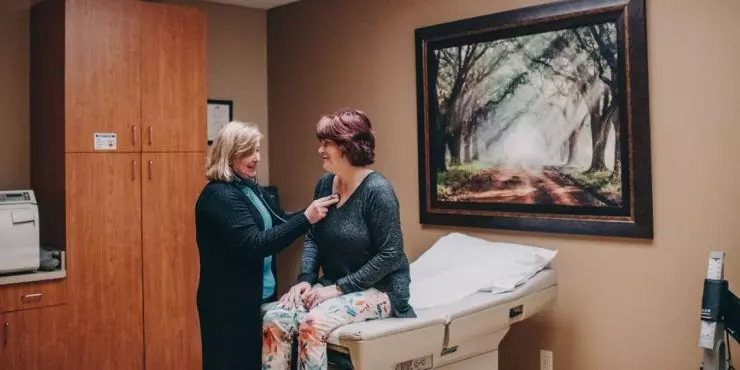
A physician assistant, or PA, is a licensed medical provider who practices in partnership with physicians. PAs diagnose and treat illness, order and interpret tests, prescribe medications, and perform many office procedures. You'll often see "PA-C" after their name; the "C" means they're board certified.
One note on the name: it's Physician Assistant, not Physician's Assistant. PAs are trained medical providers, NOT personal assistants to a doctor. Some PAs and professional organizations now use the title "Physician Associate," which better reflects how they practice.
The path to becoming a PA
- Undergraduate degree: A four-year bachelor's degree, usually in the sciences, plus hands-on healthcare experience before applying. Many PAs first worked as EMTs, medical assistants, athletic trainers, or in other clinical roles.
- PA program: A master's-level program of roughly two to three years. The first half is classroom and lab work in medicine; the second half is clinical rotations across specialties such as family medicine, pediatrics, surgery, emergency medicine, women's health, and mental health.
- Certification: PAs must pass the Physician Assistant National Certifying Exam (PANCE) and maintain certification through continuing education and periodic recertification.
What PAs do
In primary care, a visit with a PA looks much like a visit with a physician. PAs:
- Diagnose and treat illnesses and injuries, from colds to chronic conditions like diabetes and high blood pressure
- Order and interpret lab tests, X-rays, and other imaging
- Prescribe medications (PAs can prescribe in all 50 states)
- Provide physicals, preventive care, and wellness visits
- Perform office procedures such as stitching lacerations, joint injections, skin biopsies, IUD placement, and splinting
- Explain diagnoses and treatment plans so you leave feeling informed
PAs can work in nearly every specialty, including surgery, where they often serve as first assistants and manage care before and after operations. Unlike physicians, PAs don't complete a residency; they build expertise on the job, and they can move between specialties over a career.
Working as a team
PAs practice collaboratively with physicians. At Northwest Family Clinics, every PA has physicians they work with closely. Most of the time, your PA manages your care independently. If something becomes more complex, they can consult with a physician down the hall or bring one directly into your care, often during the same visit. You get the benefit of two sets of eyes without a separate appointment.
How to choose the right provider
Any of the three can serve as your primary care provider. A few things worth considering:
- Your health needs. If you have a complex or specialized condition, ask which providers in the practice have the most experience with it.
- Availability. PAs often have more open appointments, which can mean being seen sooner for same-day or urgent concerns.
- Hands-on care. If you're interested in osteopathic manipulative treatment for musculoskeletal issues, ask whether a DO in the practice offers it.
- Fit. Your relationship with your provider matters most. Choose someone you feel comfortable with and who listens to your concerns.
Frequently asked questions
Can a PA be my primary care provider?
Yes. PAs serve as primary care providers at many practices, including ours, and are fully qualified to handle routine care and chronic conditions. Their collaborating physicians are always available when needed.
Are DOs fully licensed physicians?
Yes. Both DOs and MDs are fully licensed physicians with the same training length, residency programs, and scope of practice as MDs. The two degrees are equivalent.
Is there a difference in quality of care between an MD and a DO?
No. Both provide the same high standard of care. Individual physicians differ in style and experience, but not because of which degree they hold.
Can a PA specialize?
Yes. PAs work in nearly every field of medicine, from pediatrics to surgery, and can change specialties over the course of a career.
Deciding what's right for you
Choosing between a DO, MD, or PA comes down to your preferences, your health needs, and who you connect with. All three are highly trained professionals committed to your care. If you're unsure, ask about a provider's training, experience, and approach; we're happy to answer.
At Northwest Family Clinics, our DOs, MDs, and PAs work together every day as one team. Whether you're managing a chronic condition, staying on top of preventive care, or dealing with something new, we're here to support you.